Saturday, 15 June 2013

Everest

Everest was in the media lots a few weeks ago. There was all this hullabaloo about a heated fist fight featuring Ueli Steck, and then a nutter in a wingsuit performed a high-altitude base jump. Yes... in this modern day and age, just getting to the top of Everest doesn't really mean anything.

Since Edmund Hillary and Tenzing Norgay made the first ascent 60 years ago, more than 3500 people have successfully reached the top (and made it down again). This might not seem like a very large amount, but the number of yearly ascents grows every year, and considering the fact that the seasons and conditions allow such a small window of opportunity for success, there is no escaping the fact that Everest is now overcrowded. Probably a very tiny percentage of those who successfully reach the top are professional mountaineers. The majority are guided on this 'glorified walk' for sums of money reaching past $100,000 and some clients are even short-roped and pulled to the top with minimal effort on their part. Base-camp is filled with litter that past climbers have left behind to avoid carrying it out on their backs, and the concentrated number of people in the area has led to uncontained sewage and general disturbance to the environment.

Personal opinions aside, the fact remains that standing on the top of Everest doesn't carry the same level of glory as it did 60 years ago. If I divulge my opinions I'd add that with people being able to pay their way to the summit, its become more like an extortionate tourist attraction than a heroic feat. Perhaps one day it will be just like all the great European cathedrals, where you pay to get inside and you also need to buy an extra ticket to go up to the cupola. In my opinion, nature should be free, and if you don't have enough experience to get to the top, then you shouldn't be up there in the first place. Not only because it shouldn't be an achievement you can pay for, but because Everest is a dangerous place. Yes, 3500 different people have stood on the summit but there have been over 230 reported deaths, and exposure to the extreme conditions has severely injured or impaired countless others.

I love mountains but I do not have the intention of climbing Mount Everest. I neither possess the skill nor will to, and my interest in outdoor pursuits lie elsewhere than in paying to belong to the elite club of Everest. I'd rather challenge myself in other ways, and Everest shouldn't be a paved toll road, it should be a challenge; a winding, overgrown path of twists and turns where getting to the end unscathed is actually something to be proud of.

As part of my outdoor anthology, I did an illustration for an article written by Ernest F. Imhoff titled '
Mount Everest No Place For Trophy-Collecting'. The article isn't very recent but the same issues are still true if not even more apparent.. Here is the final illustration!


Saturday, 11 May 2013

Degree Show!

Here is a photo I took just before we were all kicked out of the studio (they are very strict about the 4pm deadline). It's a bit dark so I will try and get a better one before the actual show, but you can kind of see what it looks like. I hope the pictures on the right that look a bit squint aren't actually, I measured them all with a spirit level but things can get bumped and moved as the walls they are on are just giant pieces of relatively thick cardboard.

Overall I'm pretty pleased with it though, I'm really looking forward to presenting this at my viva on Monday, as well as during my pitch for the Deutsche Bank Award which I have been shortlisted for!


Walden

It certainly has been a very very busy few weeks. Nothing like a deadline is there? Today I finally managed to get a whole 9 hours of sleep, but in the final 3 days before the deadline I slept a total of 6 hours. I think the adrenaline of getting everything ready was keeping me awake... and very very busy.

Now everything is all set up and so I can finally catch up and tell you about all the things that I've been doing and seeing and smelling and all that exciting stuff.


First I will start with Walden, the last project that I completed for the degree show. Of course I did those travel posters as well, but it only made up a portion of what I submitted in the end, as I really wanted to show some printmaking as well. In retrospect I wish I'd done those posters as linocuts because I find printmaking so much more enjoyable. They would have been much simpler of course, but to be perfectly honest, the one I like the best is the Cairngorms poster and that is probably the simplest in terms of colours and things. It would probably have taken me a lot longer though, so I would have needed to drop all the other things I was working on since January and work on those exclusively. Never mind, it is something to consider for the future! If only my brain functioned in a way that I could look retrospectively on things I'm doing NOW, then I could achieve the perfection of what I want to do.

So about the print making... I did a series of prints to illustrate quotes from Walden: Life in the Woods, a book by Henry David Thoreau, an inspiring individual 'an American author, poet, philosopher, abolitionist, naturalist, tax resister, development critic, surveyor, historian, and leading transcendentalist' (Wikipedia). From 1845 to 1846 Thoreau lived in a cabin that he built himself near the shores of Walden Pond, in Massachusetts. As a resident, he lived off the land, fishing, planting his own crops, living as frugally as possible and and generally removing himself as far from conventional society as he could. He was not completely remote, as the village was not far, but he chose to live on the border of civilisation, taking what he thought was best from each world. He was still an avid reader, visited with village members and integrated occasionally, however he did not approve of the expansion of trade and commerce and admonished every aspect of life that he did not deem necessary or did not agree with. In the summer of 1846 Thoreau ran into the local tax collector who asked him to pay 6 years of neglected taxes, but Thoreau refused leading him to be sent to prison. His refusal was based on his opposition to the Mexican-American War and slavery. After a night in jail, he was released as a relative had paid off his taxes against his will, but the experience set a lasting impression on him.


"Most of the luxuries and many of the so-called comforts of life are not only not indispensable, but positive hindrances to the elevation of mankind."
— Thoreau


 During his time in the woods Thoreau made many observations both on nature, and on society. He was a well learned man and writes about the evenings he spent reading as rain poured outside. He is known as a leading transcendentalist, a philosophy which protests certain aspects of society that corrupt the individual. The core belief of transcendentalism is that there is goodness in people and in nature, but that this purity is disrupted by society. Only when people are truly self-reliant and independent can they be the best they can be, and that is where a true community is formed.


So that is a bit of background information about Thoreau, now here are some images of my prints! These also feature in a little bound book with the images appearing next to the quotes.


Saturday, 4 May 2013

Scotland

The time has now come for me to finally reveal this secretive project that has been in the works for a long time now. I started working on these way back in the fall of last year, although at that stage it was all research. You may remember my pen and ink drawings?  That was preparation for this!


A golden eagle surveys the great wilderness of the north-west and a ptarmigan camouflages itself in the snows of the Cairngorms.


The noble red stag on the backdrop of the three sisters and a pine marten against the backdrop of the Trossachs, one of the few remaining areas of the Caledonian pine forest.

These posters have gone through many many revisions and changes, and it has proven to be a challenge. These will feature in my degree show as A2 posters, and as they are being mounted now by A&M imaging I am very excited to see them. I only had a brief look at the giclee prints and that is the only time I have seen them bigger than A4 size so I'm hoping everything will turn out grand.

I plan on doing more of these, so far it has been 4 months of the year and I have completed 4, so I am going to go for 1 a month. For now you may view these however, hope you enjoy!

Tuesday, 16 April 2013

Spain: Gaudi, Picasso & Climbing

Hello!

I just got back from a week in Spain where I was taking a break from working so I could return and be refreshed and powered up for the final push till the degree show!

Now I am back, but I saw many exciting things in Spain that I wanted to share with you. My trip was primarily with the purpose of climbing, because the limestone crags in Siurana are some of the best in the world, but we were flying in to Barcelona and I wanted to see some things there.

The first on my list of things was the Sagrada Familia, Gaudi's grand Basilica of immense proportions which has architecture of a Gothic style, but with a twist that it is based entirely off of patterns in nature. You can see why I wanted to go and see this now, it is not just any church. Most cathedrals don't interest me much, but something with unique, beautiful architecture and stone work does. Here are some photos looking at the most interesting parts.


S.F. was designed with three façades:, named Nativity, Passion and Glory (yet to be completed). In the above photos you can see the Passion and Nativity facades. You can see how the contrast, indeed they are on opposing faces of the basilica, one is stark and geometric, the other is elaborate and organic.


Being inside the central nave, one is immediately aware of the sense of scale. The supporting columns tower into the space above, and their form and shape give you the impression of being a very small insect in a field of flowers, or perhaps some small creature in a woodland made of absolute behemoths of trees. 


In fact, Gaudi did base the design of these columns from trees. It was very interesting to see his sketches, studies and observations which are presented in a museum on the grounds. His observations of the intricate patterns in nature are so fascinating, he was without a doubt an architectural genius. I can also really relate to his work because my illustrations are also all based on this idea of patterns in nature. Would my work every take on a giant three dimensional architectural format, it would probably look something like this.


Another thing that I found really cool about the Sagrada Familia, was how dynamic it is. As the light changes throughout the day, so does the look of the interior. Light shines through the stained glass windows, making beautiful splashes of colour on the pillars and reflecting off of glass orbs which are fixed to the four central supporting columns above the altar. As the basilica won't be finished until 2026, 100 years after Gaudi's fatal collision a tram (quite a mundane way to go for someone so inspiring), I can look forward to seeing in the future, should I not also be hit by a tram or something between then and now.

That was the most exciting part of my stay in Barcelona, and we only stayed there for two days so I didn't get to see very much. We went to Park Guell in the afternoon, and then wandered around the old town and went to the beach in the evening. Before leaving the following morning, I made a quick trip to the Picasso Museum which was also of interest to me.

The museum is curated in a way that follows Picasso's life, and so it contours the stylistic progression of his work, as he moved from painting traditional landscapes, to his blue period, rose period, african inspired art, cubism, classisim and surrealism. It was interesting to see this progression of work, and how he was influenced by being surrounded by different things. I found it interesting to see his studies for his rendition of the famous, 'Las Meninas' and the other thing I really liked which I hadn't seen before was his ceramic work. Here is a picture of a ceramic owl:


The rest of the time I was in Spain I was mostly climbing and enjoying the sun, here is a picture of me climbing a route called Lame Chucha Baby.


That is all for now, thanks fo' readin'.

Sunday, 7 April 2013

The 'Great' Outdoors

Dear friends, I am terribly sorry to have neglected you all and not written a single post about my illustrations, however I have been REALLY REALLY busy. Dissertation and degree show stress has taken over my life so I've been quiet. This weekend I am spending some time tying up loose ends and doing things I've neglected to do for the past few weeks like.. cleaning and taking out the recycling and looking after my plant family, but now I have got the time to take care of it all.

Its a good thing too as I'm going to Spain tomorrow for a short break to do some rock climbing. I hope that there will be sun as I'm sick and tired of all these seasonal mix-up shenanigans

I can also update you on some bits of the work I've been doing. Aside from working on the epic dissertation which is now done and dusted, I did some paintings about the 'great' outdoors, which is an embodying theme for my final show. You may recall the 'bleps' I did in a post last December. I did some experimental work which stems from the idea of those little figurines in the form of two gouache paintings. there may be more to come, however at this point in time I'm focusing a bit more on some other work.
Obligatory Viewpoint
Don't Feed the Bears
I also did a screen print of a spotted eagle owl. Owls are really beautiful birds and I mostly did this as an exercise, however the ideas are still the relationship between nature and pattern, and a juxtaposition of quite geometric shapes and more organic forms.

Spotted Eagle Owl


In a way this made me come full circle back to the work I was doing in second year and I think although I've experimented quite a bit stylistically, I've sort of found my way back now. 

I had a really good chat with Ben Cox from Central Illustration Agency about my work and he definitely agreed about print making being my strong point. He also liked the digital work I was doing so I think for my portfolio I will focus on those. He liked my gouache paintings but thought they were quite focused to a children's market, which is a good point and I might want to rethink the execution of those as they weren't really intended for children. I think I might try to include elements of print within the image to tie it together more strongly with my other work.

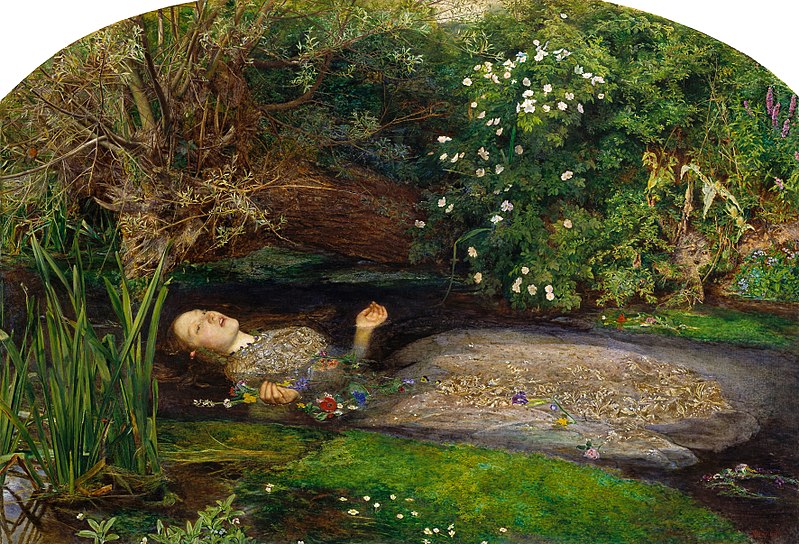
Lastly I spent a short amount of time doing another illustration to put on the cover of a business funding proposal. I ended up liking the idea and illustration quite a bit so I might continue this as a series. The illustration is a new take on a scene that has been depicted countless times, the death of Ophelia in Shakespeare's Hamlet. I've always love the Pre-Raphaelite painting of Ophelia by Sir John Everett Millais, however other paintings of the same scene are often time very similar and always depict a woman in the river surrounded by flowers, and in my opinion they quite often look a bit kitsch. 

Ophelia - Sir John Everett Millais
In my version I wanted to tell the story of Ophelia without actually showing her in her entirety. Gertrude's speech depicting Ophelia's death is so poetic and visually beautiful that I don't think its necessary to focus on the whole scene, so I only wanted to show fragments. I would like to develop this into a triptych but for now I shall show you the first of the series.

Ophelia 1

That is all I will show for now. I shall leave you with some interesting thoughts that I've been discussing with Danielle after listening to a radio programme about whether having a baby is at all sustainable. Disposable nappies are clogging up the environment and so it poses the question whether it is a necessity, or whether it is just convenient. As a baby I was wrapped in cloth nappies because they didn't have disposable ones in Poland. These were still perfectly hygienic as they could be sterilised in boiling water so why is the notion so far out there for most parents today? Also, is toilet paper a necessity? Think about it... in some countries there are other ways of staying hygienic. Not exactly the most poetic topic to end a post with but it can spark an interesting debate.